
Almonds are a delicious and healthy snack for humans. They provide several key vitamins and minerals, easy to carry around, and their high levels of healthy fats and proteins can keep us full.
For these reasons, they are more popular than ever as a snack food.

But what about your Boston Terrier? Can she eat almonds, and if so, are they healthy? Or should you avoid feeding her any almonds?
Personal Story – Bella has eaten a whole bag of almonds and has lived to tell the tale!
Topics Covered
Almonds As Snacks For Boston Terriers…?
Here is what I found out about Boston Terriers being able to eat almonds.
Can My Boston Terrier Eat Almonds?
Almonds are not toxic to Boston Terriers. However, despite being safe for her to eat. Almonds are not the best choice for her as they can cause digestive issues and potentially lead to worse problems (source ).
).
She will more easily be able to consume almond butter and almond milk than whole almonds.
This is because she chews food differently than you. When she eats almonds, larger chunks will pass through to the stomach, which can cause digestive issues.
Make sure to avoid almond butter with additives, though, especially those containing xylitol, as xylitol is dangerous to dogs.
Do Almonds Have Any Health Benefits for My Boston Terrier?
Your Boston can eat almonds, but they don’t have many health benefits for her. The issue is that almonds have high amounts of fat and fiber, too much to be an appropriate dietary choice for her (source).
Yes, almonds do have copper, magnesium, manganese, vitamin E, and other essential nutrients.
However, the number of almonds your Boston must ingest to obtain a sizable amount of these nutrients would not be healthy for her.
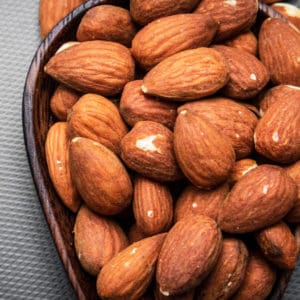
Can Almonds Put My Boston Terrier in Danger?
Plain almonds without additives are not inherently toxic to your Boston, but they can still cause some health issues, both minor and severe.
As a smaller breed, your Boston is especially at risk of almonds obstructing her esophagus, windpipe, or intestines. This can be fatal if not addressed right away. For this reason, you should avoid whole almonds.
Other Short-Term Health Problems
In the short term, if she eats too many almonds at once, she might experience gastrointestinal distress.
Symptoms include upset stomach, diarrhea, and vomiting.
Other Long-Term Health Problems
Regular consumption of almonds (which are high in fat) may contribute to pancreatitis in your Boston, as a high-fat diet is known to be a factor in this disease (source).
Issues With Additives
Then there are almond additives. Salt, sugar, and spices can irritate her stomach and cause other digestive issues.
Salted almonds, in particular, can increase water retention in your Boston, which can be dangerous if she has heart disease.
How Many Almonds Can I Feed My Boston Terrier?
Whole almonds can sometimes cause digestive issues/distress, but one or two whole almonds here and there shouldn’t be a huge deal.
Always be wary of the signs of breathing obstruction. Since she’s on the smaller side, you need to be careful, ensuring you feed almonds in moderation.
When in doubt, skip whole almonds entirely.

My Boston Ate Almonds Without My Permission. What Do I Do?
This depends on the number of almonds she eats.
If she only eats one or two, observe for signs of obstruction. Monitor her for diarrhea and vomiting over the next 6 to 12 hours.
If you do not notice any symptoms, the almonds may not be a cause for concern. Still, if you’re concerned, it’s better to take your Boston to the veterinarian just in case.
If you notice any change in her appetite signs she may be experiencing belly pain after eating one or two almonds, you should take her to the vet right away.
Want to talk to a veterinarian now? Check out Pawp.com. Here you can talk to a veterinarian via text, phone, or video.
Can Boston Terriers Eat Other Kinds of Nuts?
Your Boston is good to eat peanuts as well in moderation. Follow the same cautions and guidelines as when feeding her almonds: feed sparingly. But all other nuts should be avoided in general.
Be sure to avoid additives/spices/salt/sugar on the nuts you do give your dog. And if feeding your Boston Terrier peanut butter, watch out for xylitol.
Healthy Alternatives to Almonds
If you’re looking to vary your Boston’s diet beyond her dog food, you have plenty of options aside from almonds. These include:
- Meat
- Poultry
- Eggs
- Carrots
- Cooked fish — Make sure it’s boneless
- Apples — avoid giving your Boston the seeds
- Plain popcorn
- Green beans
Like with almonds, avoid using seasonings on any of these foods.
Final Thoughts…
Overall, almonds are ok for your Boston to eat, but not ideal. They generally shouldn’t be fed to your dog intentionally.
Still, if she eats one or two on accident, there usually is nothing to be worried about.